News
Great Lakes Commission leads fight against web trafficking of aquatic invasive species
The Great Lakes Commission (GLC) announced today that it has completed development and testing of an innovative web data mining tool to find aquatic invasive species for sale on the internet, and is continuing with implementation of the tool. The GLC is receiving $340,000 in Great Lakes Restoration Initiative funding from the U.S. Environmental Protection Agency to work with invasive species managers to apply the Great Lakes Detector of Invasive Aquatics in Trade (GLDIATR) to shield against this threat.
“GLDIATR uses advanced technologies to search the web for sites where aquatic invasive species can be purchased and shipped to the region,” said Tim Eder, executive director of the Great Lakes Commission. “We’ll be using this grant to continue our work protecting the Great Lakes from invasive species that can both decimate an ecosystem and inflict economic damage on cities and businesses.”

The homepage interface for GLDIATR, the Great Lakes Detector of Invasive Aquatics in Trade.
E-commerce is recognized as a growing way that species can be transferred into areas where they might be invasive. Both a patchwork of regulations on species and the growing global online marketplace can make it difficult to find and prevent sales of restricted species. GLDIATR has the capacity to efficiently provide information on this pathway to those working to prevent invasive species introduction and spread. In the first 30 days of full-scale testing alone, GLDIATR scanned over 300,000 web pages and identified 200 websites with invasive species for sale, including 56 restricted species. In response, the GLC contacted website owners with information about invasive species regulations and best practices and observed changes to stock and/or shipping restrictions in 27 cases.
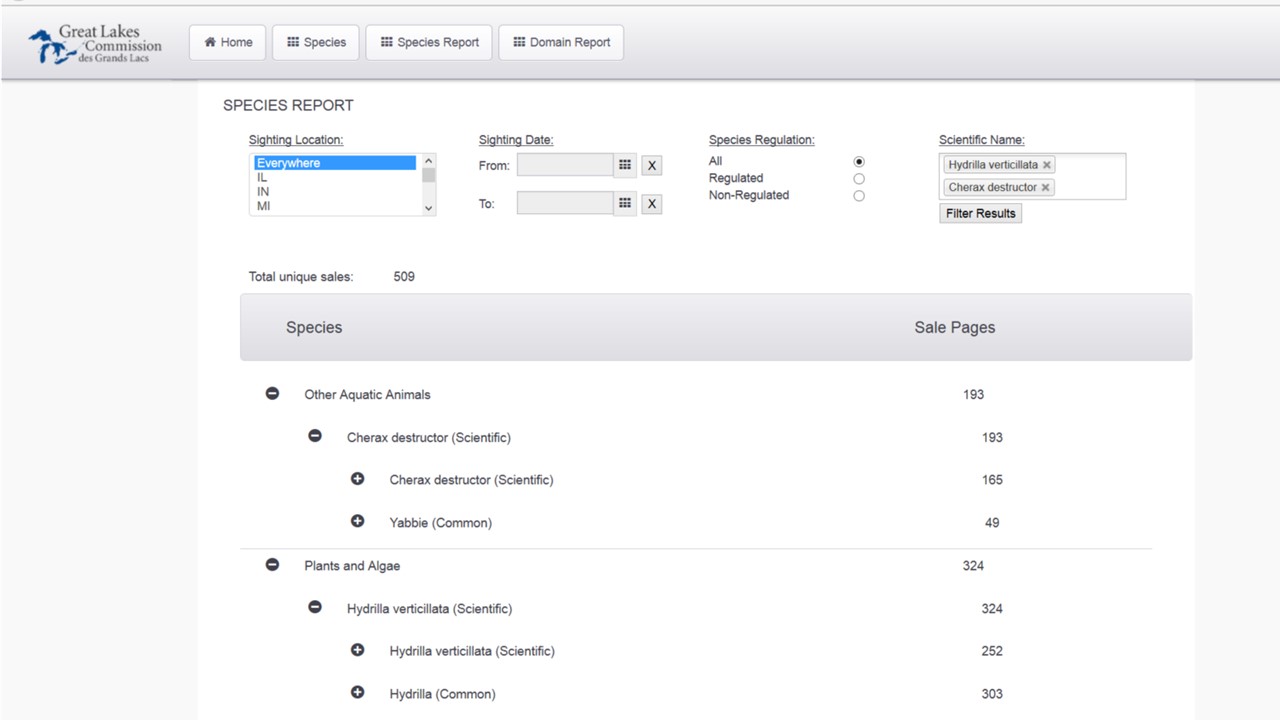
The search interface for GLDIATR, the Great Lakes Detector of Invasive Aquatics in Trade.
“While we know certain aquatic invasive species are bought and sold over the internet all across the world, it is extremely challenging to find and keep track of what is being sold by whom,” said Jon Allan, director of Michigan’s Office of the Great Lakes and chair of the Great Lakes Commission. “GLDIATR will help us track down invasive species available for sale and give us another tool to help prevent these species from getting into our lakes and wreaking havoc on our natural resources”
GLDIATR, developed with the assistance of RightBrain Networks, employs both natural language processing and machine intelligence components to scrape, sort and collect thousands of pages across the internet, focusing on keywords including both the scientific and common names of species across auction sites and search engines. The software can identify whether or not a page contains information about an actual sale or trade and provides a basis for outreach, education and, if necessary, follow up action from law enforcement agencies.
“The Great Lakes Restoration Initiative is investing in cutting-edge efforts to shield the lakes that we all love from invasive species,” said Cameron Davis, senior advisor to the USEPA Administrator Gina McCarthy. “The Commission’s GLDIATR is another example of the GLRI forward-leaning, proactive protection measures.”
With the second round of funding, the GLC will work with a team of partners to refine and expand the use of GLDIATR, including targeting sales of high risk invasive species and developing customized user interfaces and reporting for each Great Lakes state and province.
A summary report on the development and initial implementation of GLDIATR is available here.
# # #
The Great Lakes Commission, led by chairman Jon Allan, director of the Michigan Office of the Great Lakes, is an interstate compact agency established under state and U.S. federal law and dedicated to promoting a strong economy, healthy environment and high quality of life for the Great Lakes-St. Lawrence region and its residents. The Commission consists of governors’ appointees, state legislators, and agency officials from its eight member states. Associate membership for Ontario and Québec was established through the signing of a “Declaration of Partnership.” The Commission maintains a formal Observer program involving U.S. and Canadian federal agencies, tribal authorities, binational agencies and other regional interests. The Commission offices are located in Ann Arbor, Michigan. Learn more at www.glc.org.