Agriculture, Climate and Water Use
About Agriculture, Climate and Water Use
At the Great Lakes Commission’s 2024 Semiannual Meeting a policy resolution was adopted on Understanding Impacts to Great Lakes Agriculture and Water Use Under Changing Climate Conditions. With support from The Joyce Foundation, Great Lakes Commission staff have worked with experts from around our region to gather information answering key questions that arise within and from the resolution.
- What are the current or baseline conditions for agricultural production within the Great Lakes basin and across our states and provinces?
- What might we grow in the future under changing climate conditions?
- What does the future hold for agricultural water use within the basin?
Through a first phase of work, current conditions have been depicted within an interactive data dashboard. The next phase, also supported by The Joyce Foundation, will look to the future and engage additional experts to understand our region’s thirstiest crops and how patterns in irrigation may shift by mid-century and beyond.
Additional information has also been gathered to understand what is known about carbon storage on agricultural land and potential ramifications for flood and drought resilience. Finally, resources have been developed to explore similarities and differences among Great Lakes states and provinces with respect to agriculture and management of groundwater resources.
Agriculture in the Great Lakes
Phase 1 Summary Report: Impacts to Great Lakes agriculture and water use under changing climate conditions
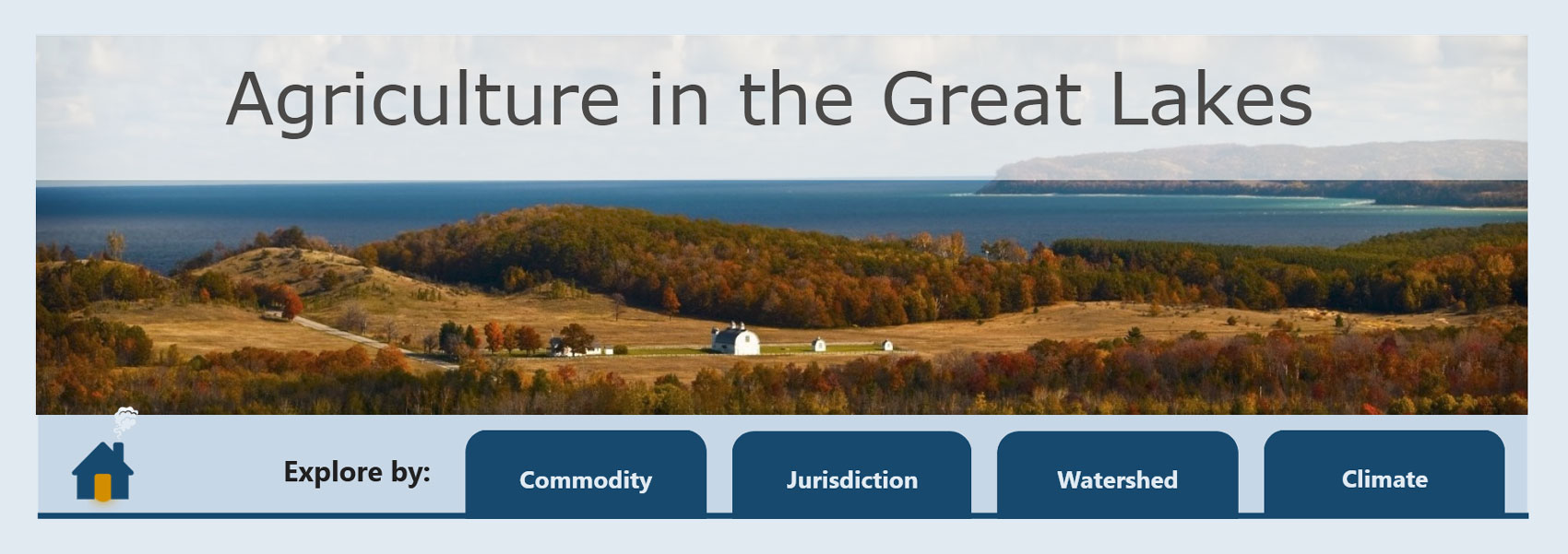
As a companion to the above linked report, a web-based dashboard app was developed to allow users to explore baseline conditions for agricultural activities across the Great Lakes basin and recent patterns of change. Click the link or the image below to explore the dashboard.
Click to view full screen dashboard
.
Groundwater Management
Often referred to as the “sixth Great Lake,” the total volume of groundwater within the Great Lakes basin is estimated to be greater than the volume of Lake Michigan. Despite its scale and connection to the quality and quantity of Great Lakes surface water, extensive knowledge gaps exist regarding groundwater availability at the state-wide, basin, and regional scales. This regional groundwater management synthesis serves to expand The Joyce Foundation’s Groundwater Governance in EPA Region 5 report to the entirety of the Great Lakes region. For additional details on how each Great Lakes state and province manages groundwater, please refer to the individual jurisdiction groundwater management summaries created by the Great Lakes Commission with support from The Joyce Foundation.
Policy Summary: Groundwater Management in the Great Lakes Region
Agricultural Carbon Storage
A growing body of research indicates that implementing conservation practices that reduce phosphorus inputs and improve water quality may also enhance the carbon storage capacity of agricultural soils, leading to improved soil health and providing resilience to flooding events and drought conditions that impact the ecosystems, communities, and economy of the Great Lakes region. This issue brief synthesizes existing literature on the ability of agricultural land to capture and sequester carbon and methods of measuring and documenting the extent of carbon sequestration over time.
GLC Issue Brief: Agricultural Carbon Sequestration in the Great Lakes Region – December 2025
Funding
Funding for this project is provided by the Joyce Foundation.
For More Information
Nicole Zacharda
Program Manager
[email protected]
Sign up for our e-newsletter
Get the latest Great Lakes Commission news and events in your inbox!
Sign up for our e-newsletter
Get the latest Great Lakes Commission news and events in your inbox!